 Wodensthrone
is sort of a new entity within the black metal scene. Can you give
me a bit of band history and expand on some of the ideas and themes behind your
style and sound?
Wodensthrone
is sort of a new entity within the black metal scene. Can you give
me a bit of band history and expand on some of the ideas and themes behind your
style and sound?Interview with Wodensthrone 2007
by Bradley Smith
Wodensthrone
is sort of a new entity within the black metal scene. Can you give
me a bit of band history and expand on some of the ideas and themes behind your
style and sound?
The clan was formed back in the latter part of 2005 consisting initially of Xaen, Andriev, Druadan, and Vortheck. We originally played black metal in the vein of more traditional bands like 1349, Satyricon, Immortal, Mayhem, and Burzum. The lyrical themes at this point focused mainly on the darker middle age periods of British history such as true stories, abstracts of murder and torture, as well as the great battles and folklore of that era. This only lasted for a short while before we began to progress, naturally, towards a more atmospheric, epic sound, drawing influences from bands like Primordial, Drudkh and Enslaved among others. The lyrical focus also became more precise, dealing with Britain’s forgotten, yet glorious, heathen past and the natural beauty of this ancient land. We ended up focusing the lyrics on ‘Woden’ and everything that could tie into this Anglo-Saxon personification. The heathen way of life is very close to our hearts, so it gives us a large area to cover from a lyrical perspective. We weren’t trying to prove anything, but we did feel that it about time for British black/heathen to metal unearth itself. We are trying to bring a little glory to Britain in this respect.
You guys have been eagerly awaiting the release of your Split 7” with Niroth. How did that project come together and what can we expect from that release?
We had wanted to release the split 7” for quite some time but it took a lot longer than expected to produce. We first thought about it collectively around April of 2006. Initially we were going to release something on our own, perhaps a demo tape or CD-R of some sort with around 4-5 tracks on. But then we talked about it some more and we decided to release it with another British band to represent a more patriotic front. We wanted to collaborate with a band that we felt shared a similar set of ideals and ethics. As soon as we found Niroth we knew straight away that we wanted to work with them. We played a show with them in our hometown, and then approached them with the idea of doing a split, which they were more than happy to be a part of. We decided to record the song entitled “A Tribute to our glorious dead” around August time. The recording itself was done on a 16-Track on the top floor of a pub in Sunderland named ‘The Borough’. The harsh surroundings such as the stage made from beer crates and a broken wardrobe certainly set the scene.
Once we had completed the recording and received a newly recorded track by Niroth we sent it off to be pressed onto 7”. The split was originally due for release around September / October but it ended up being mid December due to unforeseen complications. We can’t describe our side of the split in anyway less than being subjective but with this release you can expect literally two different sides of British black metal. We are very proud of the release and it is an honour to stand alongside our good friends Niroth.
You guys added Antares on synth in April 2006 and brought a different aspect and depth to the song writing. How did his inclusion affect how Wodensthrone approaches song writing and how is the material different now than from the earlier days?
As our sound progressed, we began to notice that something was missing, and so Druadan introduced Antares to the clan in April 2006. Around this time we had written ‘Mara’ and ‘A Tribute To Our Glorious Dead’ which saw the ‘Wodensthrone’ sound evolving and taking huge steps towards a more atmospheric and emotional feel.
Antares’ addition made the writing process a lot more interesting
and the music became more epic and very sorrowful in parts, the synths filling
out the sound and allowing us to express ourselves in new, different ways.
Lyrically we began to progress too, as both Antares and Xaen began contributing
lyrical and conceptual material alongside Andriev, which lent a more
pagan-oriented aspect to the music. It was at this time that Wodensthrone first
truly came to be what we are now. However, after a number of live shows, we
still felt that something was missing, and so in late 2006 Zherneboh joined the
clan on 2nd guitar to complete the line-up. Now that we are finally
complete, we are working hard, concentrating heavily on writing new material and
working on future releases.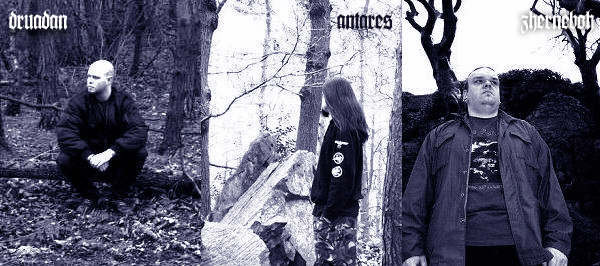
Is it hard for you guys to convey your musical ideas accurately in the live environment? How many shows have you guys done already and what sort of elements do you incorporate in to your performance?
We don’t find it difficult at all when playing live; it can be quite enjoyable for us. We are however slightly divided when it comes to the idea of playing gigs, i.e. some of us like the idea and some of us would prefer to just release music only. We do try to play live whenever possible, but we try to make it something of an event. So far we have played around a dozen shows, but intend playing more over the coming year.
When we play live we try to build up the same atmosphere onstage that you would hear when listening to our 7” for example. We also incorporated the use of woad paint to acknowledge the ancient tribes who populated Britain in the Neolithic periods; allowing us to express our barbaric anger.
Wodensthrone is an interesting moniker. What made you choose it? Isn’t Woden more a Germanic deity than a British one or are you tying into the Germanic roots of the Angles, the Saxons and the Jutes that settled in Britain?
In actual fact, Woden refers to the Anglo-Saxon deity who coincides with 'Wotan' the Germanic deity, as well as the more commonly known, 'Odin' of the Norse pantheon. But the name automatically ties it into the old European roots either way, especially if you take into account the Völkerwanderung. This refers to the movement of the peoples that migrated to Britain, as you mentioned. And because we understand that, we don’t see why we should limit ourselves only to topics surrounding the age of the Anglo-Saxons. For example, the title of the song ‘Mara’ actually makes reference to a malevolent female spirit who sat on the chest of sleeping folk causing them to have nightmares. This ethereal being is rooted in Old Norse folklore but also shares a strong connection to early British folklore.
One of your song titles really captures my imagination and it is “These Isolated Lands”. What lands are you referring to and what is the song all about?
Well the lyrics to “There Isolated Lands” can be seen as quite abstract but the inspiration for this song came after reading, “Looking for the Lost Gods of England” by Kathleen Herbert. The lyrics concentrate on a period of Britain’s history when these lands were quite scarce and were populated by the indigenous Britons who spoke in Pre-Celtic languages. These inhabitants actually feature in the film King Arthur as the barbaric folk who wore indigo dye and are known as, the woad warriors. One of the main inspirations for this song is that Britain itself was secluded in its elegance despite the Roman invasion which began around the year 43. The lyrics are like a calling to those that were to settle here later on.
After the Romans left these lands around 410 the Angles, Jutes, and Saxons obviously settled in the Eastern parts of Britain (and the Isle of Wight), while the Britons and Celts were forced into Wales, Cornwall and the mountain regions. The Angles were from a place named, Angeln which still exists today as part of the district of Sønderjylland in Denmark. It was they who later named these lands, Angleland or England as it’s known today. It also meant that this was like a second England and so this fascination encompassed our inspiration used to write the lyrics to this song.
A lot of people really want to travel while others find that leaving one’s homeland unnecessary. Where do you fall in this debate? Why do you feel that way and if you could visit any place where would it be and why?
As a band we do have what you may call a ‘village mentality’.
None of us travel that much. The band resides in Sunderland with the exception
of Antares who commutes from the East Midlands. He will eventually move back
here at some point. We like sticking close to home but it is not unnecessary
to leave our homeland. Most of us have done our travelling aboard to
Scandinavia, Germany, France, Netherlands et cetera, and whilst those places all
have their own great historical significance we can only really appreciate it
from a sightseer’s perspective. No matter where we are in the world,
Britain
will always be our home, and this land holds a great significance to us all.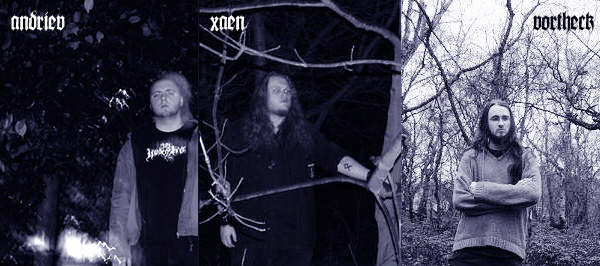
You guys pay homage to British medieval Folklore. How do you accomplish this and which topics spark your creative emotions most?
Well initially we did pay homage to medieval folklore but again, we dealt with those dark middle age periods when we first started. Our sound and conceptual ideas have developed an awful lot since then. We convey most of our ideas through our homeland. These ideas deal with things like the current state of today’s society, British history itself dating as far back as the Pre-Indo-Europeans, our heathen landmarks, Wodenism, the countryside, even Astral projection. We look within ourselves and our deepest emotions, be it good, bad or neutral. It is this, and the primal nature of the beast in man, that sparks our creativity.
Being a band from the UK which is globally renowned for such a deep and important history. How does it feel to be from a place of such historical significance especially from the Druids and the legends of “King Arthur” among others?”
When you look into Britain’s rich and glorious past, it brings a sense of remembrance and pride that one should only embrace. Yet we feel that our history has been neglected for too long. You mentioned King Arthur, and yes he certainly has a great significance to British history but so do the brothers Hengest and Horsa who fought in the conquest of Britain at the Battle of Aylesford. You also mustn’t forget things like the Vikings destroying the churches of Christian scum when they raided Lindisfarne around the late 700s. Britain is globally renowned for many reason, we could honestly talk about it forever if we had the time, but it’s pleasing to know that Britain was actually once populated by pagans/heathens. It’s just a shame that we can’t be as content with today due to the present state of our nation. None of us live in the past though and we are certainly not callow about it. We know that we couldn’t even really comprehend it so we don’t even try to pretend. We only feel that we should honour and remember our nation’s glorious heritage.
For an outsider visiting Britain what would you say would be the most important Pagan/heathen landmarks and sites to visit in order to commune properly with those roots of heritage and why do you think they are so important?
We could be here all day in reply to this one too. If you didn’t know already this country is full of pagan/heathen landmarks. It is strewn with castle ruins, stone circles, ancient forests, battlefields, and monuments that have endured centuries of affliction. Places of historical importance are places like Hastings, Avebury, Jorvik, Portchester Castle (which was once occupied by the Saxons), Cornwall, Wales, the Scottish highlands, Sherwood Forest; even Sunderland has its own share of history and folklore. On top of this areas such as the Pennines hold a special place in our hearts, as their stark natural beauty is a reminder of the Britain that once was.
We shouldn’t really need to point out the importance of the landmarks mentioned as it should be quite obvious by now. But an outsider really shouldn’t go to any of Britain’s larger, congested, shameless, filth ridden cities. It makes us angry just thinking about it.
What are the upcoming plans for Wodensthrone? Are you guys going to be recording/releasing any new material? Do you have any live performances scheduled?
This year didn’t really kick off to much of a good start as one member is going through some difficult personal circumstances at the moment. However we are confident that justice shall prevail, and it hasn’t stopped us from working hard to achieve our goals. We have the full line-up now and the flame is burning stronger than ever with spirits high! We are currently getting ready to enter the studio again to record another track for our forthcoming split with another British band who share our ideals and mentality. This should be coming out in the late summer with any luck, and will also be available on CD, so that those who refuse to use the classic vinyl format will not be disappointed this time. We are also in the process of writing material for our full-length, which won’t be ready for a good while yet, although we have been talking to a respected underground label who may be releasing it. Apart from that we hope to play some more shows this year and keep the flame burning bright.
Final Words as a tribute to our Glorious Dead are yours.
While the phrasing of this question is somewhat an affront to our beautiful tongue, we would simply like to extend our Hails and respects to the Gods, Britain, and the bands and people that have supported us so far. We would also like to extend special thanks to Niroth for being so easy to work with, and for their great contribution to our record. It has been an honour! Finally, thank you for this interview. Take care out there in Qatar!