Interview
with Chris of 7
Generations 2013
by
Bradley Smith
 As I am pretty new
to 7 Generations and have been out of touch with the scene for awhile,
I was
wondering if you could give me a bit of background into the birth of
the band?
How did you guys meet and what was the motivation for the band? What
philosophies
guided your music and lyrics and what bands did you consider
influences? And
finally, where did you come up with the name for the band?
As I am pretty new
to 7 Generations and have been out of touch with the scene for awhile,
I was
wondering if you could give me a bit of background into the birth of
the band?
How did you guys meet and what was the motivation for the band? What
philosophies
guided your music and lyrics and what bands did you consider
influences? And
finally, where did you come up with the name for the band?
John
Johnson, the original guitarist of 7 Generations, and
I were in an animal rights band together called “Sentient.” The band
was not
very fruitful or functional and broke up after a demo and one show.
Upon the
break up of Sentient in early 2003, John said that he thought he and I
should
continue working on a band together. The Orange County vegan
straightedge was very
small at the time, being about only 15 people who were actively engaged
in the
hardcore or activist scenes, so John and I were already friends with
the other
folks with whom we wanted to work on a new band.
Our motivation was to form a band that could
reinsert some discussion of radical leftist politics into the hardcore
scene.
In the southern California hardcore scene at the time, there was a near
complete
dearth of bands discussing radical politics. This was in the wake of
9-11 and
the war in Iraq was just about to get under way, so the atmosphere in
the
entire country, as I’m sure you recall, was very aggressively
nationalist and
reactionary. Unfortunately, hardcore in southern California mirrored
this
paradigm to a considerable degree. Most of hardcore was dominated by
overly
ornate, fashionable metal core that aspired to mainstream success, was
largely
vacuous in content and completely unlistenable. There was already a
revolt
against this trend in the form of a reemerging youth-crew revival scene
and a
nascent Los Angeles thug scene, but the revolt was mostly superficial.
Both
primarily defined themselves as separate from the fashioncore trend
only by the
style of music they played or the clothes they wore, but basic
attitudes
remained androcentric, misogynistic, nationalistic, and
anti-intellectual. The
members of 7 Generations wanted to contribute what we could to
providing an
alternative to the nauseating effluvia that had so completely saturated
this
time and place. We therefore decided that our band would be intractably
outspoken and radical in political orientation and that we would use
the music
we created as a vehicle for activist fundraising and community building. We all came to the effort
with very little in
common. The minimal territory of overlap between our various
perspectives was
that we were all vegan, eco-centric, straightedge, and cleaved to some
variety
of far left political ideology. Different members had different
idiosyncratic
interests and beliefs, but we knew we could work together on the basic
project
of creating a band that would
harken back to the radicalism of many of the mid-90s
hardcore bands we admired, such as Chokehold, Born Against, Struggle,
Earth
Crisis and Trial (though individual tastes in music varied among the
members
even more than did political ideology,) a spirit we felt was sadly
absent from
the hardcore scene of the time and an essential component to a dynamic
subculture. Our band name was our drummer Tim’s idea, which he had
wanted to
use due to his admiration for Native American culture. The name stems
from the
constitution of the Iroquois Nations, which states “In our every
deliberation,
we must consider the impact on the seventh generation.” Tim felt that
this
ideology had considerable congruity with the overarching eco-centrism
that informed
of our collective paradigm at the time. (It should
be noted that 7 Generations more or less had two distinct eras of
existence.
The first from 2003-2006 and the second from late 2006-2009. Except for
Tim and
myself, there were different line ups for these different eras and the
second
era had a far more cohesive character than did the one presently under
discussion.)
 The
only album, To
See The End really made an impact on me. The quality of the music and
the
passion of the vocals/lyrics really stood out. Can you give me some
insight
into its creation and what you were trying to achieve with the album? I
mean were
you trying to make a statement or set of statements with it?
The
only album, To
See The End really made an impact on me. The quality of the music and
the
passion of the vocals/lyrics really stood out. Can you give me some
insight
into its creation and what you were trying to achieve with the album? I
mean were
you trying to make a statement or set of statements with it?
I
am very grateful that you feel that way. Thank you. To
See The End would be the release I would want to define the band more
than any
of the others, so your focus on that album is deeply appreciated. The
record
was written by a band that was very much mortally wounded. After the
exodus of
the members of the first line up, the remaining members (Tim, Adrian
and
myself) were exhausted and disheartened. Yet, our friend Nicholas
James, who
had been in the band Hellfire Trigger, with whom we played several
shows,
called me one day and offered so much support and encouragement that he
should
be largely credited with the band’s decision to carry on and rebuild.
Nicholas
was asked to join the band on bass and our friend Kevan Aguilar, who
had been a
kind supporter of ours for some time, joined on second guitar. This new
line up
took a break from shows and set to work on recording new material,
because the
old line up’s vision of the band had become so discordant that we had
been
playing multiple
shows on a monthly
basis and touring regularly for two years with no new material. The new
membership
of the band shared far more in common, both in terms of political
vision and musical
influence, so a far greater degree of fruitful cooperation became
possible. The
music was reoriented to focus more on emotive 90s bands such as
Unbroken and
Undertow, certain politics that had to remain implicit became explicit,
such as
feminism and anti-theism, and the lyrical aesthetic became more
existential. Musically, Adrian becoming the main guitar
player rather
than Erik (from the previous line up) meant that someone with a far
more
enthusiastic attitude to writing music and a more nuanced taste in
hardcore was
now at the helm. He came to practice first with the music for what
would become
Vanguard and Apostasy, and later Ritual, Falling Grains of Sand and
Derrumbado,
all of which were far more exciting, dynamic and emotional than Erik’s
writing,
which had become first static and then completely absent. Kevan on
second guitar
added a more fitting source than John’s guitar playing would have
because John
was mostly into 80s hardcore like Judge, which we all could appreciate
but was
not terribly fitting with the style we were playing (though I by no
means intend to convey that John was anything but a great
fellow traveler for the time he was in the band.) Kevan was more
influenced by
Catharsis, Refused and His Hero Is Gone, so he was capable of adding
some dark
and chaotic elements to the backdrop of Adrian’s riffs. In addition,
Kevan
wrote the music to Endymion and reconstructed Adrian’s original
structure to
Falling Grains of Sand into the form that would eventually be recorded
on the
full length. Nicholas joining the band added to it a bassist who
understood the
fundamentals of rhythm far more than any previous member had, and so
his
playing really rounded out the riffs in a more full and tempered
fashion than
before (this is, of course, not to disparage our previous bass player,
who was
a very capable musician and put on a tremendous live performance.) The
drop
into a more mid-tempo, darker style of playing allowed Tim to
experiment on drums in such a way that he could attempt to emulate some
of the
drummers that had been more influential on him, such as Bloodlet, Rage
Against
the Machine and Quicksand. As for lyrics, I was given far more free
reign in
the new line up to follow my inclinations and aesthetic preferences
than I had
before. Some influences from outside of hardcore were vital in helping
me create what I hoped could be my new voice, so to
speak. Further immersion in some of my favorite poets, such as Percy
Bysshe
Shelley, John Keats, William Butler Yeats and Dylan Thomas, as well as
the
writings of my favorite poetry critic Harold Bloom, helped me progress
as a song
writer and to try to evolve away from pedagogy and sloganeering.
Additionally,
the new style in which my bandmates were writing allowed me to try to
incorporate some of the euphony of Morrissey and Leonard Cohen’s
lyricism or
Bruce Springsteen’s story telling on the album The Ghost of Tom Joad.
The
primary shift in lyricism was one away from activist militancy and
toward a
personal and existential viewpoint that was rooted in having deeply
felt, passionate
beliefs for which one wanted to live, yet simultaneously being caught
up in a
world that was absurd, callous, intricate and far beyond one’s
personal efficacy in bringing about change. Behind all the lyrics on
that
record is a sense of one’s own insignificance, imperfection and
pettiness
mingled with a desire strive toward authenticity with one’s beliefs and
to
attempt to transcend present personal limitations. The attitude I was
attempting to convey was that we may be incapable of changing the world
for the
better, we may be up against something far more powerful than our
individual
efforts can hope to contend, yet the likelihood of our own futility
cannot
drive us to renege on our commitment to acknowledge a common plight
with one
another, nor can it cause us to succumb to despair, forsake our
conscience and
wallow in cynicism. The stress on the individual psyche that thus
results from
the antagonistic forces of what Freud called the limitless
transcendental self and the limited animal
self, one side being internal and capable of imagining perfection and
omnipotency while the other side is external and subject to mortal
reality, was
the muse for the songs on To See The End. I wanted to try to have my
own dreams
and shortcomings as a person with an acute sense of duty to my
political and
social conscience laid bare for others to see so that they could
hopefully find
something with which they identified and thus we could commune with one
another
in an attempt to stave off alienation, disillusionment and conformity.
As far as specific songs go, Chimera is the most definitive
of the entire project. It is about the will to resist domination and to
believe
in a transformed and just society despite the likelihood of failure. It
is
about a vision enduring beyond the limitations of possibility. Rising
of the
Sun, a rerecorded song from the era of the first line up, is
essentially a song
about the yearning for revolutionary change and the imperative to
recognize
one’s own freedom as vitiated by the oppression of others. Ritual is an
indictment of the animal murder industry. The song is intended to draw
the
attention of the listener to the fact that a piece of meat is the end
result of
a string of events that began with a living, feeling, sentient creature
being
born into unremitting captivity, raised its entire life in horrendous
conditions in which it
is regularly brutalized and tormented, finally ending in a horrific and
violent
murder. Vanguard is a song addressed to a specific individual, our
former
guitarist who at the time went by the name Vanguard but has recently
changed
his name to Rik Dachau, who surreptitiously used his position in the
hardcore
scene (as a member of 7 Generations, Tears of Gaia and Inhumane Nature)
and his
male privilege to indulge a predatory sexuality that relied upon the
coercion,
blackmailing and demonizing of women. Though the title of the song is
used to
single out one male who pursued non-consensual sexual conquests, the
purpose of
the song is to state that men do not have the right to disregard a
woman’s
bodily autonomy for their own sexual gratification. In Wolves’ Clothing
is a
song about the necessity for hardcore to be underground and
self-sufficient if it is to be a vital and meaningful subculture.
Falling Grains of Sand is about the
inescapable reality of pain and suffering as part of an individual life
and the
need to accept this reality as an invitation to grow into a wiser and
more
fulfilled being rather than to drown it out with tactics for evasion
and repression,
such as intoxication or denial. Derrumbado is about the plight of
impoverished immigrants
who come to prosperous countries in an attempt to gain for themselves
and their
families the sort of security that has been elusive in their home
countries.
This song was written in 2007 as immigration was hotly debated in the
then
upcoming election and was intended to rebuke the slander of immigrants
voiced
by conservatives, nativists and racists, and instead encourage
solidarity,
understanding and compassion for poor and working class immigrants.
This song
was specifically inspired by the stories told to me by a couple who
came to
this country illegally and lived with my family for some time in the
90s. I wrote Apostasy about my experiences with Christianity in my
youth. It is about the
way in which belief in an afterlife drains the present life of its
vivid beauty
and how faith in a perfect being strips one of faith in oneself,
causing one to
attribute all personal virtues to divine assistance while attributing
all personal
shortcomings to oneself. Endymion, the closing track, is simply a song
about
despair and failure. It is about the inability to be seen by others the
way one
understands oneself, the pain that led Sartre to write that “hell is
other
people.”
There
is the Viva
Hate Edge LP which as I understand it is just a different version of To
See The
End. Is that true? Why the different cover? And it appears to be an
obvious
Morrissey influence on the artwork, is that correct?
The
Viva Hate Edge LP was just a limited cover for the To
See The End LP that we printed up as a special edition for our last
show at the
Che Cafe in November 2009. It is a takeoff of the artwork for
Morrissey’s Viva
Hate LP. Instead of Morrissey on the cover, we have our good friend and
collaborator Chris Conner photographed by our friend Tosh Clemens. We
just
wanted to pay homage to our dear patron saint while giving our fellow
record
collectors something for which they could hunt. In fact, Chris managed
to
deliver a copy of the Viva Hate Edge LP to Morrissey years later during
a live
show.
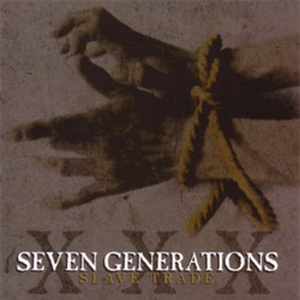 Your
Slave Trade
EP was just a precursor to what was in store on the debut, however by
itself it
was still a powerful dose of SxE hardcore. What all went into the
recording and
writing for that EP? Was that your first real experience in the studio?
What
lessons did that recording teach you that you applied to the album?
Your
Slave Trade
EP was just a precursor to what was in store on the debut, however by
itself it
was still a powerful dose of SxE hardcore. What all went into the
recording and
writing for that EP? Was that your first real experience in the studio?
What
lessons did that recording teach you that you applied to the album?
The
writing and recording of the Slave Trade EP was an
exciting time period. It was the only period of the early line up of 7
Generations that happened quickly and fluidly. It was a time when the
five
personalities that comprised that line up shared a rare moment of
synergy and
congruity. As far as the music goes, John wrote the riffs to Character
Witness,
which was our first song, and No Other Way, which was written
immediately
after, and Erik Vanguard kind of polished and edited them into their
final
form. Erik then wrote the music to Slave Trade as our third song. After
we had
three songs, we played our first show in early December of 2003, the
set list
being Slave Trade, Character Witness and No Other Way with a cover of
Trial’s
Reflections to wrap things up. The show was at a venue in South Central
Los
Angeles called Casa Del Pueblo. It was a small show, but people who
would form
the nucleus of what was to become a new source of southern California
hardcore
were in attendance or playing in some of the other bands. It was a good
place
for different people who were active in and enthusiastic about their
respective
scenes to come together and begin a collaboration that would contribute
much to
the next two years of southern California hardcore. Shortly after this
show
Erik came up with the music to the song Cauterize and we were ready to
record
our demo. Unfortunately, not much can be said as to what we learned
about recording from the experience. 7
generations never had an easy time accomplishing anything, especially
practical matters like
getting recordings done in a fluid and timely fashion. We were always
learning
on the fly. Lyrically, I was given tentative permission to decide what
to write
about, so long as it conformed with the general political consensus of
the rest
of the band. Tim and I were especially involved in anti-globalization
activism
at the time, so I wrote Slave Trade about the insatiability and
criminality of
international capitalism, primarily manifested in groups such as the
World
Trade Organization (WTO), the Free Trade Area of the Americas (FTAA)
and the
World Bank. My opinion was that these organizations had achieved the
ability to
enforce free trade capitalism on any country throughout the world,
transcending
local laws that could be protecting vulnerable species, ecosystems or
peoples,
and enshrined profit as the ethos upon which global relations would be
justified, much to the detriment of the poorer nations, the working
class and
the environment. In Character Witness I attempted to vent some of the
animus I
felt toward the police. I had come to feel that the police were most
saliently
an armed force whose purpose was to protect the dominant order imposed
upon our
country by rich white people. Their brutality, the arbitrary nature of
their authority and the fundamentally
abusive nature of their relationship to common citizens was something
that I
felt earned them the just resentment and even eventual violent reprisal
of the great
majority of the people. The song Cauterize was intended to be an act of
solidarity with the various revolutionary movements throughout the
world that
sought to rectify the injustices of neo-colonialism, industrial
capitalism,
speciesism, theocracy or conservatism. It was inspired by groups like
the ALF,
the ELF, the EZLN, the Black Panthers, the Provisional IRA, and
Umkhonto We
Sizwe, for example. Lastly, No Other Way was written to express the
notion that
an end to the animal agriculture industry was both a pragmatic and
ethical necessity. The song is a polemical and anthemic
attack on the murder and confinement of animals for human consumption.
As a
polemic and anthem it is, of course, overly simplistic, but the idea
behind the
song was that the animal exploitation industry has created a crisis for
those who,
after philosophical exploration, have decided that the species barrier
is not
morally significant and thus the greatest mass murder in history is
being
accepted as evolutionarily stable, environmentally innocuous and
practicably
moral. The main purpose of the song is to reject that mindset, even to
the
extent of accepting the notion that laws must be broken in order to try
to save
animals and the planet from this monumentally destructive industry.
 You guys were
signed to New Age Records which for me is possibly the best/most
important
record label in hardcore with classic releases from Outspoken,
Unbroken, Turning
Point, Mean Season and the list goes on. Anyways, how was it to be
approached
by such a legendary label and did their roster/history play a role in
signing
with them? How was it working with them?
You guys were
signed to New Age Records which for me is possibly the best/most
important
record label in hardcore with classic releases from Outspoken,
Unbroken, Turning
Point, Mean Season and the list goes on. Anyways, how was it to be
approached
by such a legendary label and did their roster/history play a role in
signing
with them? How was it working with them?
For
me it was one of the resplendent moments that
illustrate why the hardcore community is such a special place. I grew
up
listening to all the New Age bands with great relish. Those bands did
more than
any other to shape my adolescence. I used to spend countless hours with
those
records, listening to the songs, reading the lyrics, emblazoning the
live
pictures and artwork on my mind. To have my own project offered the
chance to
be a part of the great lineage of New Age bands was the sort of
affirmation
that I do not think could have been experienced elsewhere nor could
have
even been meaningful in another context. Mike
Hartsfield has been a great friend and supporter. Working with New Age,
from my
end of things, was a positive experience
and I am very glad that To See The End has the classic New Age logo on
the back
cover.
Being
ignorant as
to the events that caused the eventual break-up of 7 Generations, I was
wondering if you could enlighten me as to what transpired and led to
the band's
demise? How do you look back on that period in your life? I mean I know
it hasn't
been that long since it happened, but how do you feel about it on an
emotional
level?
There
is not one sole reason as to why 7 Generations broke
up, but I will try to summarize as best as I can. In early 2009, I was
the one
to first mention the idea that I wanted to see the project concluded
sometime
in the near future. For quite some time I had been of the belief that
what made
a hardcore band vital was the volatile and ephemeral nature of the
whole
subculture. I have always quite liked the idea that a hardcore band was
an
aggregate of four or five different people, all with brash, unwieldy
and often
diametrical personalities, who come together and cooperate on
a
project for a short amount of time, but are eventually
driven apart by the same gelignite character traits that brought them
to one
another in the first place. I have a certain degree of skepticism
towards bands
that manage to stay together for years upon years, it often seems
indicative of
a certain lack of passion and vehemence. This, of course, is not to say
that a
band cannot manage to stay together and function seamlessly yet still
be
energetic, engaging and relevant. Naturally, most things are possible
in theory
and I am only speaking in generalities here, but I have not seen much
by way of
bands that stay together for a decade or more yet still remain
insightful,
enthusiastic, challenging and relevant. I never wanted 7 Generations to
be a band that over-stayed our welcome or continued to play
shows past our ability to evoke passion in our fellow travelers. At the
beginning of 2009, after about six years of being a band, I began to
sense that
our ability to function together was deteriorating, that things were
not going
to get much better for either ourselves or our supporters and comrades
if we
continued for more than another year, and that if we were serious about
our
message and the community that we were fortunate enough to exist
within, then
we would have to consider bidding a final adieu to the project and let
other
voices take our place. Our final show was in late October 2009 at the
Che Cafe.
We were fortunate enough to have been able to play the show with some
of our
very best friends whose bands we admired greatly, such as Gather (who
were kind
enough to reunite for our final show), Run With The Hunted, Time For
Change,
and The Separation, as well as a fun Bikini Kill cover band called
PussyWhipped,
and two new vegan straightedge bands called Abandon and Contend. The
turnout
for the show was one of the most fulfilling and enriching experiences I
have
had in my entire life. Over 500 people from all over the U.S. and from
places
as far as France, Germany, Italy and Australia, inter alia, showed up.
The show
managed to raise thousands of dollars for the Che Cafe, which was in
dire needs of funds to continue
operating. I still think back to that night with an overwhelming sense
of
gratitude and contentment. It was the most ideal seal on the band’s
existence
that I could have ever imagined and it reinforced my faith that when
you try to
give the best part of yourself to the hardcore community, it will
return the sentiment
in full. Looking back on 7 Generations, I have many, many different
feelings.
There are, of course, the things I wish had gone differently. I do not
want to
highlight anything negative about anyone else here, so I will just say
that,
for my part, I wish that I had been more patient and less partisan in
those
years. We always operated under somewhat of a siege mentality because
our band
was a lightning rod for controversy from first to last. In many ways
this was
what we had set out to accomplish, to raise the level of discussion and
reinsert radical politics into the hardcore scene, especially from a
straightedge perspective, but having to be perpetually prepared to come
under attack,
to engage in arguments, debates and polemics, to be ready for the
crudest ad
hominem indictments, all took its toll. On the other hand, and far
above what I
have just said, there are the tremendous feelings of fulfillment, hope
and good
faith in human nature that were engendered directly as a result of
being in 7 Generations. We had countless people commune with us about their
experiences in
life and share with us how our band had helped them cope or even
progress. We
got to use our band as a vehicle to raise thousands of dollars for
independent
community spaces, for political prisoners to hire lawyers, for
battered women’s shelters, for animal advocacy groups, and for the
homeless and
poor. Some of us had our houses raided by the FBI or were detained and
interrogated. We got to play shows with some of the bands that had
inspired us
in the past and others that would inspire us in the future. We got to
engage in
dialogue with an array of fascinating people participating in
meaningful
struggles. These are the dominant memories I have of our band and they
give me
energy in my personal life and faith in the continued viability of
hardcore as
a whole.
 As a band that
espoused the ideals of activism and awareness, I wanted to know what
you
thought was the most important issue facing the world today? What can
we do to
change it?
As a band that
espoused the ideals of activism and awareness, I wanted to know what
you
thought was the most important issue facing the world today? What can
we do to
change it?
“What
can we do to change things?” This is certainly the
most challenging and vexing question one with an acute conscience will
have to
ponder. As an aspiring historian, I believe it is very difficult, and
perhaps
ultimately elusive, to try to identify and articulate the causes of
change within
society throughout history. It depends on the issue under discussion,
in many
ways. One has to examine fundamental principles, such as whether or not
the
state can be a vehicle for change, if the state is ever legitimate in
the first
place, if violence is an appropriate means to an end, if change is
progressive
and piecemeal or revolutionary and holistic, if the utilitarian
paradigm is
legitimate, and so on. Each person has to explore these questions as an
individual
and I have no basis upon which I can claim to know a satisfactory
answer. To
the extent that I have explored these things myself, I would say that I
believe
change has to come as a result of dynamic efforts. I have trouble
believing
that any one view, tactic or cabal can do anything of lasting value
without
being a part of a general current of progressive effort. It seems to me
that if
a person is serious about his or her struggle, that person will want
mainstream
and underground organizing, legitimate and illegal tactics,
intellectuals and
activists, etc. In the layout to our unreleased record, I write in the
explanation to one of our songs “The dominant order that we face is
dynamic and
formidable while simultaneously capable of being elusive and subtle if
need be.
Our best hopes in subverting this order are with diversity, ingenuity
and
persistence, the kind which can only arise from a general unity and a
broad
sense of purpose.” Thus, I think what needs to be avoiding in trying to
affect
change is the sort of narrow partisanship that breeds internecine
strife and
leads radicals into a destructive spiral of mutual recrimination. It is
a sad trend
in history that revolutions tend to eat their own children, and that
one
persecutes the near rival as a villain rather than doing so to the real
primary
enemy. I am not terribly sure I can say that I know of one issue that
is most
pressing in a way that others are not. There are issues that are most
meaningful to me and that spur me to action more quickly or wrought me
to
sympathy more effectively than others, but my existential inclinations
have no objective
meaning. To my own mind, the violence done unto animals is the most
heartrending atrocity in the modern world due to its devastating
systematic
efficacy, astronomical body count and metastatic environmental
detriments. However, the
poisoning of the oceans may be more dreadful in the sense of long term
consequences. Yet again, all environmental, economic, and political
troubles
are considerably exacerbated by overpopulation, which is threatening in
and of itself
as well as crucially correlated with the aforementioned problems. Not
to
mention, overpopulation occurs at such an exponential rate that it
seems as
though it may be the looming global disaster to outweigh all others.
Perhaps
Isaac Asimov exercised too effective of an influence on me at an early
age, but
to my mind overpopulation is a practical and pressing enough problem to
transcend ideology and even justify extensive state control over the
right to reproduce.
I say this with considerable trepidation, but I believe the time during
which
the liberty to reproduce as one wishes has long been over and thus
needs to be
rescinded. (I have not discussed this with any of the members of 7
Generations,
so it should be noted that I am speaking only for my own opinion
regarding this issue.)
 Right now there is
a big battle on the global stage against Mosanto and Genetically
Modified
Organisms (GMOs) in general. What is your opinion on GMOs and the
global struggle
against Mosanto? Why do you think that they were able to get such a
foothold here
in the USA whereas in the rest of the world they are being somewhat
successful
at keeping GMOs out of their markets?
Right now there is
a big battle on the global stage against Mosanto and Genetically
Modified
Organisms (GMOs) in general. What is your opinion on GMOs and the
global struggle
against Mosanto? Why do you think that they were able to get such a
foothold here
in the USA whereas in the rest of the world they are being somewhat
successful
at keeping GMOs out of their markets?
From
what I know of economic history, the emergence of such
large and internationally influential corporations is a logical outcome
of the
laissez faire economic policy that has been a virtual religion to the
capitalist class since the gradual demise of mercantilism. When there
is insufficient
oversight of corporate growth and policy by governing bodies,
corporations will
follow the maxim “if it is profitable, it is right.” The political
structure of
the USA, since the Reagan Reaction accelerated the deterioration of
regulatory
bodies, has demonstrated very little willingness to provide the sort
information necessary to having an informed consumer population while
simultaneously pursuing Friedmanite economic policies that enshrine
unrestricted corporate growth and trade. Our nation, in a way that is
relatively unrivaled by prosperous and technologically advanced
nations, has
cleaved to the interpretation of the state as a policing body, rather
than an
organization to control and distribute the wealth of society, hence we
have an engorged military apparatus along with miserly, pallid
social and regulatory bodies. This is less the case in parts of the
world where
many socialist or quasi-socialist policies militate for the interests
of the
citizenry more effectively, though there is no hard and fast rule that
I know of
by which one can navigate global policy on neoliberal economics. Even
nominally
communist nations seem to do a terrible job curbing corporate abuse of
information and evasion of legal restrictions. In privileged nations,
there is
a real problem with the proliferation of pseudo-science within the
health food
market/lobby/community that does the issue no favors. Advocacy for
corporate
responsibility in privileged nations needs to take a dramatic turn away
from
the sort of anti-scientific mysticism and pseudo-scientific
misappropriations that have become far too common on the left these
days.
Scholarly and well-researched material needs to be consulted over
second hand,
non-peer-reviewed popular media.
One
of the big
issues going on the US right now is Gay Marriage, especially as the
Supreme
Court attempts to tackle this issue. I was wondering your thoughts on
the issue
and where you stand on making Gay Marriage legal. Also, some people see
it as a
distraction from "real" issues occurring within the government. Do
you agree, or do you see it as a truly important issue?
I
do not think any issue that addresses the inequality of
peoples before the law of the nation could ever be a distraction from
“real”
issues. The right of LGBT peoples to have equality before the law and
fundamentally equal access to benefits provided by the state is an
essential
civil rights issue because it has attending effects on employment,
taxes,
medical access, insurance and educational opportunities. If this is not
a
“real” issue, I do not know what is. Simply because there are other
political
issues that deserve government attention does not mean this issue
should be
skirted aside, such an attitude would be a capitulation to false
dichotomies.
Nor does the fact that it is only a small step in the right direction
invalidate the necessity of that step. The canard of one step “not
being enough” is often invoked, most
frequently by folks who take no steps at all and speak from a position
of
political bad faith. Some folks on the far left of this subject view
gay
marriage as a pacifier issue and a Trojan horse for the deterioration
of a
uniquely gay subculture by assimilation into the mainstream. While I am
no one
to dictate how others ought to live their lives, I think it would be a
rather
paltry politics that holds to be valid only the desires of those who
wish to
remain marginalized against those who wish to do otherwise. It seems to
me that
a great deal of what Victor Klemperer called “language that does your
thinking
for you” is utilized to justify monolithic interpretations of the
aspirations and identities of LGBT peoples. You will often hear someone
speak
of the desire not to assimilate in such a way that the person will be
presuming
that his or her opinion is definitive of the opinions of LGBT people
writ
large, but no one can rightly speak in such a manner. LGBT peoples are
as
diverse as any others, and therefore a person can speak as an
LGBT
person but not for LGBT persons. Enough LGBT
peoples have come forward
with the desire to marry and therefore receive the benefits offered by
the
state to married couples and enough have come forward with stories of
the sort
of detriments they have faced by not having their relationships
acknowledged as
legitimate partnerships by the state that one cannot justly say it is
not a valid issue to
pursue. It seems to me, the most viable and broadest approach would be
to allow
those who want to marry and therefore assimilate into the mainstream
monogamous
paradigm to do so and that in doing so one by no means precludes
possibilities
for those who want to maintain an underground, unassimilated LGBT
identity
either. The most full-blooded acceptance and empowerment of LGBT
peoples is one
that permits for all shades of political opinion among LGBT peoples to
have
traction and be taken seriously. So long as the state chooses to
privilege
married couples in a way that it does not single persons or nonmarried
partnerships,
equal access to marital options for all gender and sexual identities
among consenting
adults is a necessity in further evolving an egalitarian nation. In my
opinion,
to do otherwise is to allow retrograde theocratic interpretations and
heterocentric patterns to continue to dominate our culture’s
understanding of
partnership. Hopefully in the future we can also begin to have some
mainstream
discussion of even further progressive issues, such as evolving beyond
monogamous
and exclusivist amorous identities and undoing the cult of virginity
and possessiveness
that operate so heavily upon our cultural psyche.
 I watched that
documentary the other day, If A Tree Falls: A Story of the Earth
Liberation
Front. I must tell you I was inspired and it made me wish I was
younger, without
any REAL responsibilities so I could undertake an active role in the
struggle.
I know that 7 Generations hailed the ELF in the liner notes of Slave
Trade.
Have you seen the documentary? What do you think of their actions and
the
government's response? Do you ever get so fed up that you want to take
up the
struggle just like they did?
I watched that
documentary the other day, If A Tree Falls: A Story of the Earth
Liberation
Front. I must tell you I was inspired and it made me wish I was
younger, without
any REAL responsibilities so I could undertake an active role in the
struggle.
I know that 7 Generations hailed the ELF in the liner notes of Slave
Trade.
Have you seen the documentary? What do you think of their actions and
the
government's response? Do you ever get so fed up that you want to take
up the
struggle just like they did?
“If
A Tree Falls” is a powerful documentary, to be certain.
Ecocentric direct action activists are, in my opinion, heroic people
and their
efforts are to be greatly admired for their selflessness, their
optimism and
their bravery. Though I do not partake in those sort of actions myself,
I have boundless
respect for the activists who do so. I think their behavior is
indicative of a
beautiful humanism and I know that their willingness to act in the way
that
they do comes at a very real personal price. These activists often
sacrifice
personal security, success, psychological stability and physical well
being for
the sake of attempting to derail the breakneck journey toward
catastrophe and
extinction upon which industrial civilization has embarked. My heart is
with their
mission completely, but I am sorry to say that my actions and my will
fall
short of theirs. I have no criticism of the Earth Liberation Front or
their
tactics that can excuse my own inaction.
These individuals live in a bold authenticity with their
conscience, one
which so many of us have not the fortitude to replicate and I believe
that
they, along with the Animal Liberation Front, are among the definitive
moral
exemplars that will define the far sighted radical moral conscience of
our time
the way abolitionists, suffragettes and revolutionaries have in
previous
epochs. Many people denounce the actions of the ELF or the ALF as
counterproductive or futile. It is often revealing how regularly many
in the
radical community will run to pettifogging critiques in order to cast
aspersions on the actions of others without disagreeing with their fundamental
project nor having any deeds personally undertaken that can serve as an
alternative approach. Also, the futility critique and the perversity
critique are pillars
of reactionary obfuscation employed to discredit a political project
without
confessing personal ambivalence or hostility toward its aims, as social
scientist Albert Hirschman skillfully pointed out in his study The
Rhetoric
of Reaction. As a rather rabid atheist, I am not much on
biblical wisdom,
though I have read the bible many times and do not believe a person in
the West
can be properly literate without a certain degree of familiarity with
the King
James Bible, but I find a passage from the Gospel of Matthew
particularly
relevant. In chapter 7, verse 16, Jesus advises his disciples on how to
identify the disingenuous, saying “Ye shall know them by their fruits.”
The
beliefs of ELF and ALF activists are translated into considered, daring
and
practiced actions and I hold it as further testament to the ultimate
goodness
of the human character that there are people who are willing to
dedicate their
lives to such projects despite the enormous risk they run of draconian
legal
consequences. The laws enacted against these groups have logical
symmetry with
the mode of production for which current government structures exist.
Our
historical epoch is one dominated by free market capitalism and, as
such, it
makes perfect sense that governments would use the most brutal cudgels
in their
legal armamentarium against activists who disrupt or subvert the smooth
functioning
of a system set up to buttress unrestrained capitalism. However,
because
something makes sense according to a certain logic does not in and of
itself
vindicate that system of logic. The inability of free market capitalism
to
protect the most irreplaceable and essential global base of society,
that of the ecosystem, and the same system’s
unwillingness to curb economic activity in the face of ethical
atrocity, such
as industrial factory farming, attest to the ineluctable irrationality
and
dysfunction of the capitalist system as a global structure.
What
else doing
you have going on in regards to music, art, activism, and personal life
these
days? Anything related to 7 Generations going on? I know Adrian has
Children Of
God, but what are the other members working on?
At
the moment, Adrian is the only other member with an
active band, Children of God, recording and playing shows. Tim is
living in
Costa Rica where he has been helping to run an animal sanctuary. He has
some
musical projects in the works down there, but nothing that has come to
fruition
yet. As ever, Tim is diligently serving the cause of animal rights
advocacy
when he is in the US as well. Nicholas is living near St. Louis,
working on
getting in touch with some members of the hardcore scene there with
whom he
could start a band and he is an active member of the Communist Party of
the
United States. Kevan is in graduate school at the University of
California, San
Diego presently. I am not aware of any musical projects of his at the
moment,
but I know he is active in anarcho-syndicalist politics in the area. As
for
myself, I just graduated from the University of California, San Diego
and will
be heading to graduate school soon. I am a European History major and
am
looking to become a professor, eventually. From time to time I involve
myself
in various activists projects, usually something to do with animal
rights, but to be completely forthcoming, this is
more seldom than it should be. School took up a great amount of my time
because
I was going to school in San Diego but still living in Orange County,
so I had
about four hours of commuting every day on top of a full time school
schedule.
I have not been able to find the right musical project in which I could
get
involved, but who knows what the future holds. I am open to the idea of
doing
another band and still feel very passionate about the hardcore scene
and the
socio-political issues that have always been part and parcel with punk
music
for me.
 Thanks
again Chris
for this interview. I'll leave any final words of inspiration and
motivation to
you! Continue the struggle!!!
Thanks
again Chris
for this interview. I'll leave any final words of inspiration and
motivation to
you! Continue the struggle!!!
Thank
you very much for the opportunity. I apologize for my
glacial pace in finishing the interview and thank you deeply for your
patience.
I will close by offering two quotes that, in my opinion, should work
together
to influence one’s approach to engaging punk rock. The first is from The
Plague by Albert Camus “The evil that is in the world always
comes of
ignorance, and good intentions may do as much harm as malevolence, if
they lack
understanding. On the whole, men are more good than bad; that, however,
isn’t
the real point. But they are more or less ignorant, and it is this that
we call
vice or virtue; the most incorrigible vice being that of an ignorance
that
fancies it knows everything and therefore claims for itself the right
to
kill. The soul of the murderer is blind; and there can be no true
goodness nor
true love without the utmost clear-sightedness.”
To add
to this, one should consider the words of the late, great Christopher
Hitchens
from his Letters to a Young Contrarian “only an
open conflict of ideas
and principles can produce any clarity. Conflict may be painful, but
the
painless solution does not exist in any case and the pursuit of it
leads to the
painful outcome of mindlessness and pointlessness; the apotheosis of
the
ostrich.” Cynicism and apathy are the results of a person glimpsing the
effort
required in pursuing such clarity and being found unequal to the task.
Do not
take the cynics and the apathetic seriously, deep down even they
themselves do
not. Thank you.